API Status Codes & Meanings
 Althaf Mohamed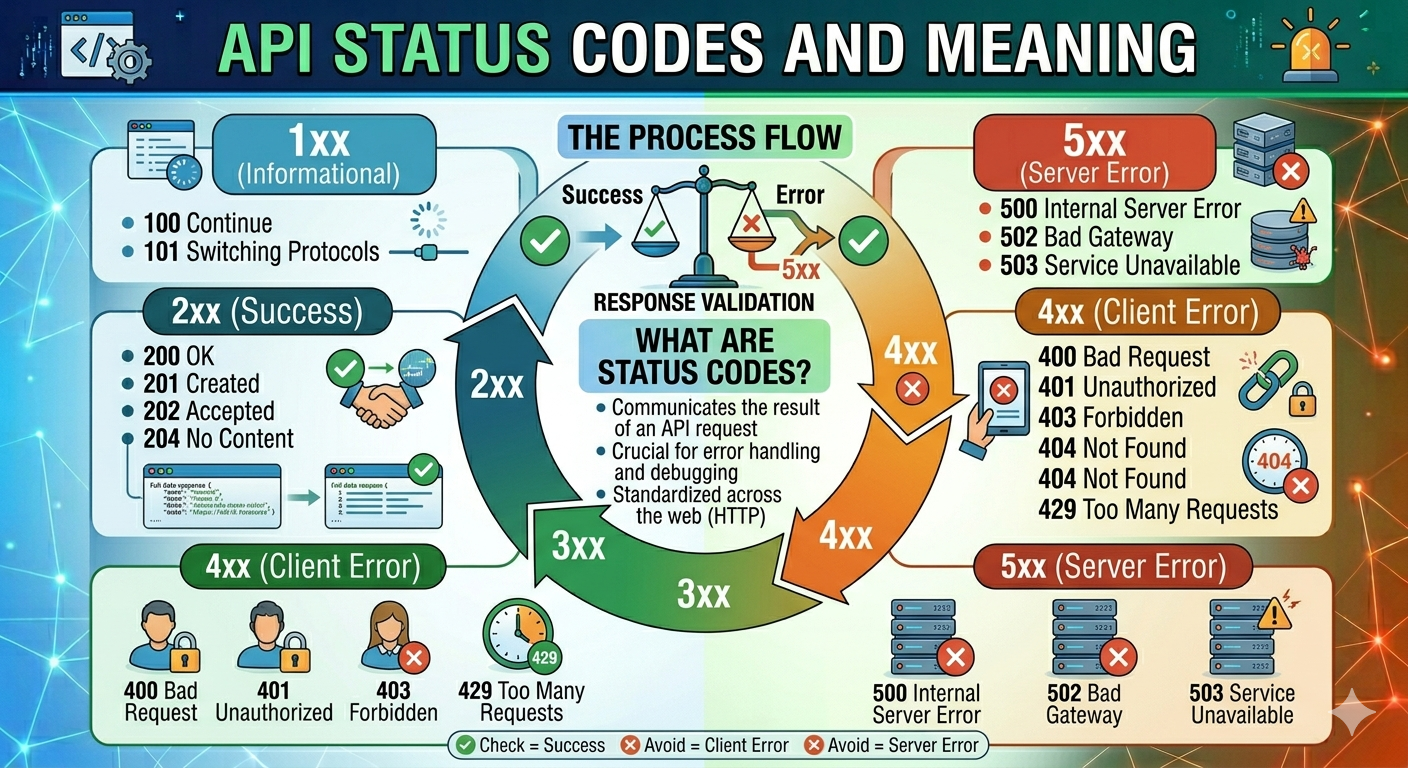
When applications communicate using APIs, the server responses to requests using HTTP status codes. These status codes assist developers determine whether a request was successful, failed, unauthorized, or met a server error.
API status codes are extremely important in web development because they provide information about the result of an API request. Whether you are building a website, mobile app, or backend service, understanding status codes helps with debugging, error handling, security, and application performance.
In this article, you’ll learn what API status codes are, how they work, their categories, common status codes.
What Are API Status Codes?
API status codes are standardized three-digit numbers returned by a server in response to a client’s request. These codes indicate the result of the request and help both developers and applications understand what happened.
Whenever a client such as a browser, mobile app, or frontend application sends a request to a server, the server processes the request and returns:
Data (if successful)
Error messages (if something went wrong)
A status code describing the result
Why Are Status Codes Important?
API status codes are useful because they allow applications and developers to understand the outcome of a request performed to a server. When a client, such as a website, mobile app, or frontend application, performs a request to an API, the server returns a status code that explains what transpired.
These status codes function as communication signals between the client and server. They show if the request was successful, failed, unauthorized, or met a server error.
Help Identify Request Results - Status codes clearly indicate whether an API request was successful or unsuccessful. This helps applications quickly understand the response.
Simplify Debugging and Troubleshooting - Developers use status codes to identify and fix issues in applications and APIs. This saves time when debugging errors.
Improve API Communication - Status codes create a standard way for clients and servers to communicate. Instead of guessing what happened, applications receive clear response information from the server.
Enable Proper Error Handling - Applications use status codes to handle errors properly and improve user experience.
Help Developers Understand Server Behavior - Status codes provide insights into how the server processed the request. They help developers understand whether the request reached the server, whether authentication succeeded, whether the server encountered issues. This improves monitoring and maintenance of APIs and applications.
Categories of API Status Codes
API status codes are classified according to the type of respond given by the server. These categories help developers to quickly determine whether a request was successful, failed, redirected, or encountered a server issue.
HTTP status codes are three-digit numbers, with the first digit indicating the response's category.
There are five main categories of API status codes:
1xx → Informational Responses
2xx → Successful Responses
3xx → Redirection Responses
4xx → Client Error Responses
5xx → Server Error Responses
1xx – Informational Responses
The 1xx status codes indicate that the server has received the request and the process is continuing.
These responses are temporary and usually occur during communication between the client and server before the final response is sent.
100 Continue → The server received the request, and the client can continue sending data.
101 Switching Protocols → The server is switching to a different protocol as requested
103 Early Hints → Suggests preloading resources before the final response.
2xx – Successful Responses
The 2xx status codes indicate that the request was successfully received, processed, and completed by the server.
These are the most common success responses in APIs.
200 OK → Request completed successfully
201 Created → New resource created successfully
202 Accepted → Request accepted for processing but not completed yet
204 No Content → Request succeeded but no data returned
206 Partial Content → Only part of the requested content was returned
3xx – Redirection Responses
The 3xx status codes indicate that the requested resource has been moved or additional action is needed to complete the request.
These responses are mainly used for URL redirection.
300 Multiple Choices → Multiple possible responses are available
301 Moved Permanently → Resource permanently moved to a new URL
302 Found → Resource temporarily located at a different URL
304 Not Modified → Resource has not changed since last request
307 Temporary Redirect → Temporary redirect while keeping the same request method
308 Permanent Redirect → Permanent redirect while keeping the same request method
4xx – Client Error Responses
The 4xx status codes indicate that the problem is caused by the client or user request. These errors occur when the request is invalid, authentication fails, the resource does not exist.
400 Bad Request → Invalid or malformed request
401 Unauthorized → Authentication required or failed
402 Payment Required → Payment needed to access the resource
403 Forbidden → Access denied even with authentication
404 Not Found → Requested resource not found
405 Method Not Allowed → HTTP method not supported for the resource
406 Not Acceptable → Server cannot provide requested response format
408 Request Timeout → Client request took too long
409 Conflict → Conflict with current server state
410 Gone → Resource permanently removed
413 Payload Too Large → Request body size exceeds limit
415 Unsupported Media Type → Unsupported request content type
422 Un processable Entity → Request format valid but contains semantic errors
429 Too Many Requests → Too many requests sent in a short period
5xx – Server Error Responses
The 5xx status codes indicate that the server failed to process a valid request due to internal problems.
These errors are caused by server-side issues rather than client requests.
500 Internal Server Error → General server-side error or failure
501 Not Implemented → Server does not support the requested functionality
502 Bad Gateway → Invalid response received from another server
503 Service Unavailable → Server temporarily unavailable or overloaded
504 Gateway Timeout → Server took too long to respond
505 HTTP Version Not Supported → HTTP version not supported by server
API status codes are required for communication between clients and servers. They assist applications in determining whether requests were successful, failed, unauthorized, or affected by server faults.
Understanding HTTP status codes is essential for frontend developers, backend developers, mobile app developers, and anyone who works with APIs. The proper use of status codes enhances debugging, security, performance, and overall application quality.
Frequently Asked Questions
Althaf Mohamed
Technical Author
Software Engineer and technical author specializing in web architectures, databases, and secure distributed systems.
Trending Now

Recent Posts

Beginner's Guide to Software Development: Everything You Need to Know in 2026
May 30, 2026
TypeScript vs JavaScript - Key Differences
May 04, 2026API Status Codes & Meanings
May 04, 2026
What is an Application Programming Interface (API)
May 04, 2026
Network Security Basics – Threats & Protection Methods
May 04, 2026