TypeScript vs JavaScript - Key Differences
 Althaf Mohamed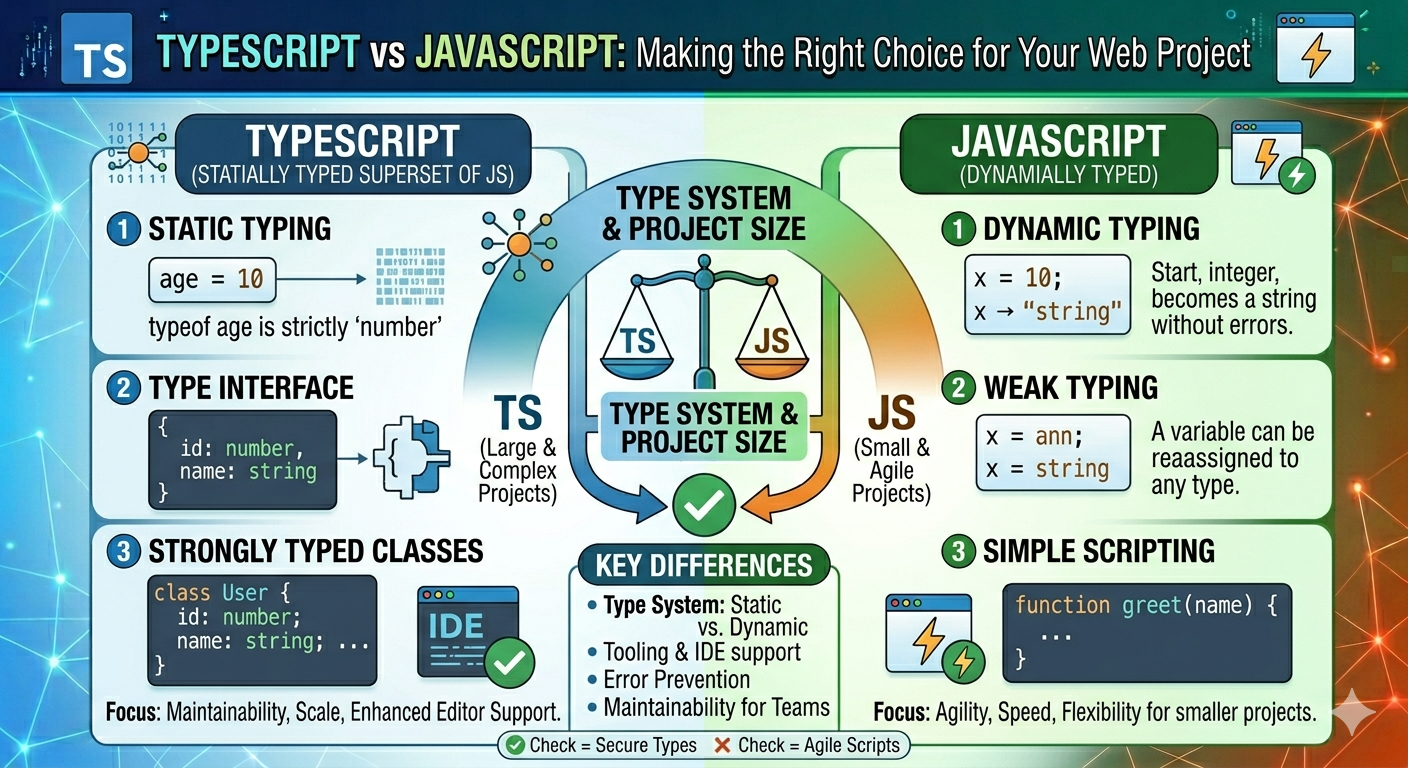
In the world of web development, the debate between JavaScript (JS) and TypeScript (TS) is one of the most common discussions. While sharing same roots, they provide developers with quite diverse experiences.
JavaScript is one of the most popular programming languages used for building web applications. However, as applications grow in size and complexity, managing code becomes challenging. This is where TypeScript comes in. TypeScript is a superset of JavaScript that adds static typing and modern features to improve code quality and maintainability.
We'll examine the differences between TypeScript and JavaScript in this article, along with their features, benefits, and when to use each.
What Is JavaScript?
JavaScript is a dynamic, interpreted programming language used to create interactive and dynamic web applications. It runs in the browser as well as on the server (using Node.js).
JavaScript has long been the foundation of modern web development, powering everything from simple websites to complex web applications. However, as projects grow in size and complexity, managing JavaScript code can become challenging due to its dynamic nature and lack of strict type checking.
Key Features of JavaScript
Dynamically Typed
JavaScript is a dynamically typed language, which means you don't have to declare the data type of a variable when declaring one. The type is automatically determined during runtime.
This makes development faster and more flexible, but if not handled correctly, it might lead to runtime issues.
Easy to learn and use
JavaScript has a basic syntax and is easier to learn than many other programming languages. It does not require any complex configuration and may be written straight in a browser.
Runs Directly in the Browser
JavaScript can execute in web browsers without being compiled. This enables developers to quickly build interactive webpages without requiring additional tools.
Large Ecosystem and Community
JavaScript has one of the largest developer communities in the world. There are thousands of libraries and frameworks available, such as React, Angular, Vue.js as well. This strong ecosystem makes it possible for developers to have simple access to solutions, robust community support, and a wealth of learning resources.
Supports Event-Driven Programming
JavaScript is designed to handle mouse movements, keyboard input, and clicks. For creating dynamic web apps and interactive user interfaces, JavaScript is perfect.
What Is TypeScript?
TypeScript is an open-source programming language developed by Microsoft. It is a superset of JavaScript, meaning all JavaScript code is valid TypeScript, but TypeScript adds extra features like static typing.
TypeScript code must be compiled into JavaScript before running in the browser.
Key Features of TypeScript
Static Typing
TypeScript introduces static typing, which requires you to specify the data type of variables when writing code.
This ensures that variables always contain the correct type of data, reducing unexpected errors.
Better Error Detection at Compile Time
One of the most key benefits of TypeScript is that it detects errors before the code is executed, during the compilation process.
This allows developers to detect bugs early, reduce runtime errors, and improve code reliability.
Supports Interfaces and Classes
TypeScript supports interfaces and object-oriented programming (OOP) concepts such as classes, which improves code structure.
Improved Code Readability and Maintainability
TypeScript significantly enhances code readability and maintainability, especially for large applications. Its usage of types results in clear explanations of expected data, changing the code into a self-documenting language. This clarity allows team members to better understand each other's code.
Works Well for Large-Scale Applications
TypeScript is tailored for large, complex applications, particularly those developed by teams. Its benefits include improved code structure, easier debugging, a scalable architecture, and robust IDE support with features like auto-complete and suggestions.
Real-world applications such as enterprise systems, SaaS platforms, and frameworks like Angular and Next.js leverage TypeScript for enhanced scalability.
Key Differences of TypeScript & JavaScript
Feature | JavaScript | TypeScript |
|---|---|---|
Typing | Dynamic typing | Static typing |
Error Detection | Runtime errors | Compile-time errors |
Syntax | Simpler and flexible | More structured and strict |
Learning Curve | Easy for beginners | Moderate (requires understanding of types) |
Scalability | Less suitable for large applications | Highly suitable for large-scale applications |
Tooling Support | Basic IDE support | Advanced IDE support with autocomplete & type checking |
Compilation | No compilation required | Requires compilation (TypeScript → JavaScript) |
When to use JavaScript & Advantages of using JavaScript
JavaScript is especially useful for developing small projects, making simple websites, learning programming, and rapid prototyping. For example, a small portfolio website or landing page can be effectively developed with JavaScript, showcasing its capability to facilitate quick and simple web development tasks.
JavaScript has several advantages, that making it a popular choice for web development. Firstly, it is simple to learn, allowing learners to quickly understand the language. Unlike many other programming languages, JavaScript does not require compilation, that simplifying the development process. Additionally, it is widely supported all major browsers, ensuring user accessibility. Finally, JavaScript has a large community and a diverse set of libraries that provide developers with an extensive tools and support, further improving its usability and functionality.
When to Use TypeScript & Advantages of using TypeScript
TypeScript is most useful when developing large-scale applications, especially in enterprise-level systems and collaborative team contexts. It improves code maintainability by ensuring a structured and type-safe environment. Because of these benefits, deploying TypeScript on a large e-commerce platform or SaaS application can be extremely beneficial.
TypeScript has several advantages that significantly improve software development. Its capabilities for early error detection helps in identifying issues during the coding phase, which reducing runtime errors. Additionally, TypeScript encourages improved code structure through static typing, resulting in more legible and maintainable code. This helps to boost developer productivity since clear contracts in the code allow developers to work more efficiently. For large projects, TypeScript makes maintenance easier, making it a better choice than JavaScript. Furthermore, TypeScript is well supported by modern frameworks such as Angular, React, and Next.js, which strengthens its position in modern web development.
Both JavaScript and TypeScript are effective tools for modern development. JavaScript is appropriate for beginners and small projects, whereas TypeScript is best suited for large-scale systems that require more structure and maintainability.
The size of your project, team, and long-term goals will all influence which one you choose. In many cases, developers begin with JavaScript and gradually transition to TypeScript for improved scalability.
Frequently Asked Questions
Althaf Mohamed
Technical Author
Software Engineer and technical author specializing in web architectures, databases, and secure distributed systems.
Trending Now

Recent Posts
Beginner's Guide to Software Development: Everything You Need to Know in 2026
May 30, 2026TypeScript vs JavaScript - Key Differences
May 04, 2026
API Status Codes & Meanings
May 04, 2026
What is an Application Programming Interface (API)
May 04, 2026
Network Security Basics – Threats & Protection Methods
May 04, 2026