React vs Next.js - Key Differences
 Althaf Mohamed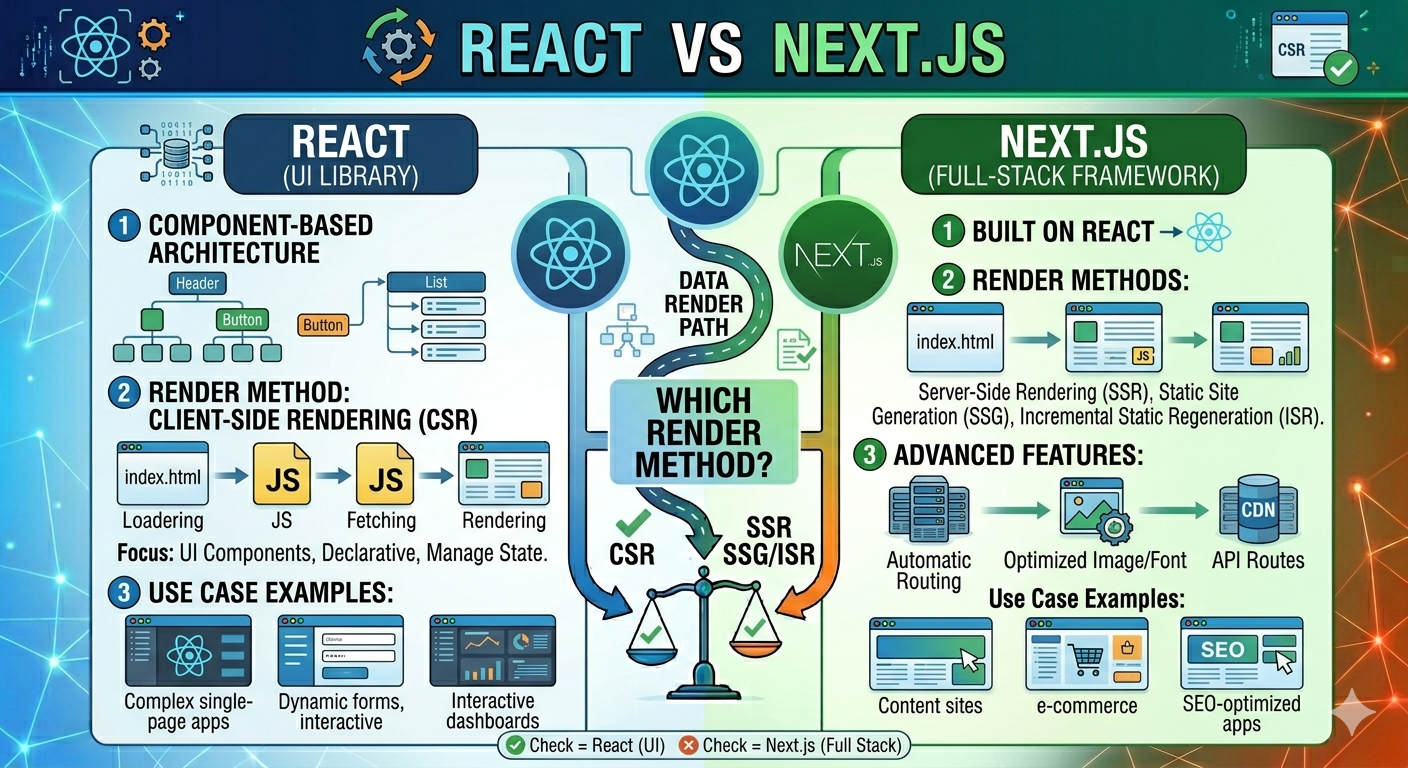
When developing modern web applications, two of the most popular technologies to consider are React and Next.js. While they are closely similar, they are not the same—and selecting the correct one can have a big impact on your project's performance, scalability, and SEO.
React is a powerful JavaScript library for creating user interfaces, while Next.js is a full-featured framework built on top of React that includes server-side rendering and routing.
In this article, we’ll explore the differences between React and Next.js, their features, use cases, and help you decide which one is best for your project.
What Is React?
React is a popular open-source JavaScript library developed by Meta for building user interfaces, especially single-page applications (SPAs).
React focuses only on the view layer (UI) and allows developers to create reusable components.
Key Features of React
Component-based architecture
Virtual DOM for fast rendering
Strong ecosystem and community
Flexibility to choose tools (routing, state management)
Ideal for building dynamic user interfaces
Example Use Cases
Dashboards
Single-page applications
Interactive web apps
When need to use React
You are building a single-page application (SPA)
SEO is not a major concern
You want full control over tools and architecture
You are developing highly interactive UI applications
Advantages of using React
Highly flexible and customizable
Large ecosystem and community
Great for dynamic applications
Easy to learn for beginners
Challenges of React
Requires additional setup (routing, SEO, SSR)
Not ideal for SEO-heavy applications
Needs some extra libraries
What Is Next.js?
Next.js is a React-based framework developed by Vercel that provides built-in features for production-ready applications.
Next.js extends React by adding server-side rendering (SSR), static site generation (SSG), API routes, and file-based routing.
Key Features of Next.js
Server-side rendering (SSR)
Static site generation (SSG)
File-based routing
API routes (backend support)
Built-in SEO optimization
Image and performance optimization
Example Use Cases
SEO-friendly websites
Blogs and content platforms
E-commerce applications
Full-stack applications
When needs to use Next.js
You need SEO-friendly applications
You want better performance and fast loading
You are building blogs, e-commerce, or marketing websites
You want a full-stack solution with backend support
Advantages of using Next.js
Built-in features (routing, SSR, API)
Better SEO support
Faster performance
Full-stack capabilities
Challenges of using Next.js
Slight learning curve for beginners
Less flexibility compared to pure React
Overkill for small projects
React vs Next.js – Key Differences
React | Next.js |
|---|---|
A JavaScript library for building user interfaces. | A complete framework built on top of React. |
Uses Client-Side Rendering (CSR) by default, where pages are rendered in the browser. | Supports Server-Side Rendering (SSR), Static Site Generation (SSG), and CSR to improve performance. |
Requires external libraries like React Router for navigation. | Provides built-in file-based routing, making navigation easier. |
Limited SEO support because content loads on the client side. | Excellent SEO support, including server-side rendering and pre-rendering. |
Best for single-page applications (SPAs) and highly interactive UIs. | Best for SEO-friendly websites, blogs, e-commerce, and full-stack applications. |
Requires manual setup for routing, state management, and optimization. | Comes with pre-configured setup, reducing development time. |
Performance depends on how well the developer optimizes the app. | Performance is optimized by default, including automatic code splitting and image optimization. |
There is no built-in backend support; a separate backend is required (for example, Node.js). | Includes API routes, which enable backend functionality inside the same project. |
It is easier for beginners to get started with UI development. | Advanced features like as SSR and routing cause the slope to be slightly steeper. |
React and Next.js are both powerful tools in modern web development. Understanding your project requirements is key to choosing the right technology. For selecting a web development framework, choose React for its flexibility in building UI-heavy applications. Choose Next.js if you require better SEO, performance, and a comprehensive framework. Generally, for modern web projects, Next.js tends to be the preferred option, particularly for applications ready for production.
Frequently Asked Questions
Althaf Mohamed
Technical Author
Software Engineer and technical author specializing in web architectures, databases, and secure distributed systems.
Trending Now

Recent Posts

Beginner's Guide to Software Development: Everything You Need to Know in 2026
May 30, 2026
TypeScript vs JavaScript - Key Differences
May 04, 2026
API Status Codes & Meanings
May 04, 2026
What is an Application Programming Interface (API)
May 04, 2026
Network Security Basics – Threats & Protection Methods
May 04, 2026