SQL vs NoSQL – Which Database Should You Choose?
 Althaf Mohamed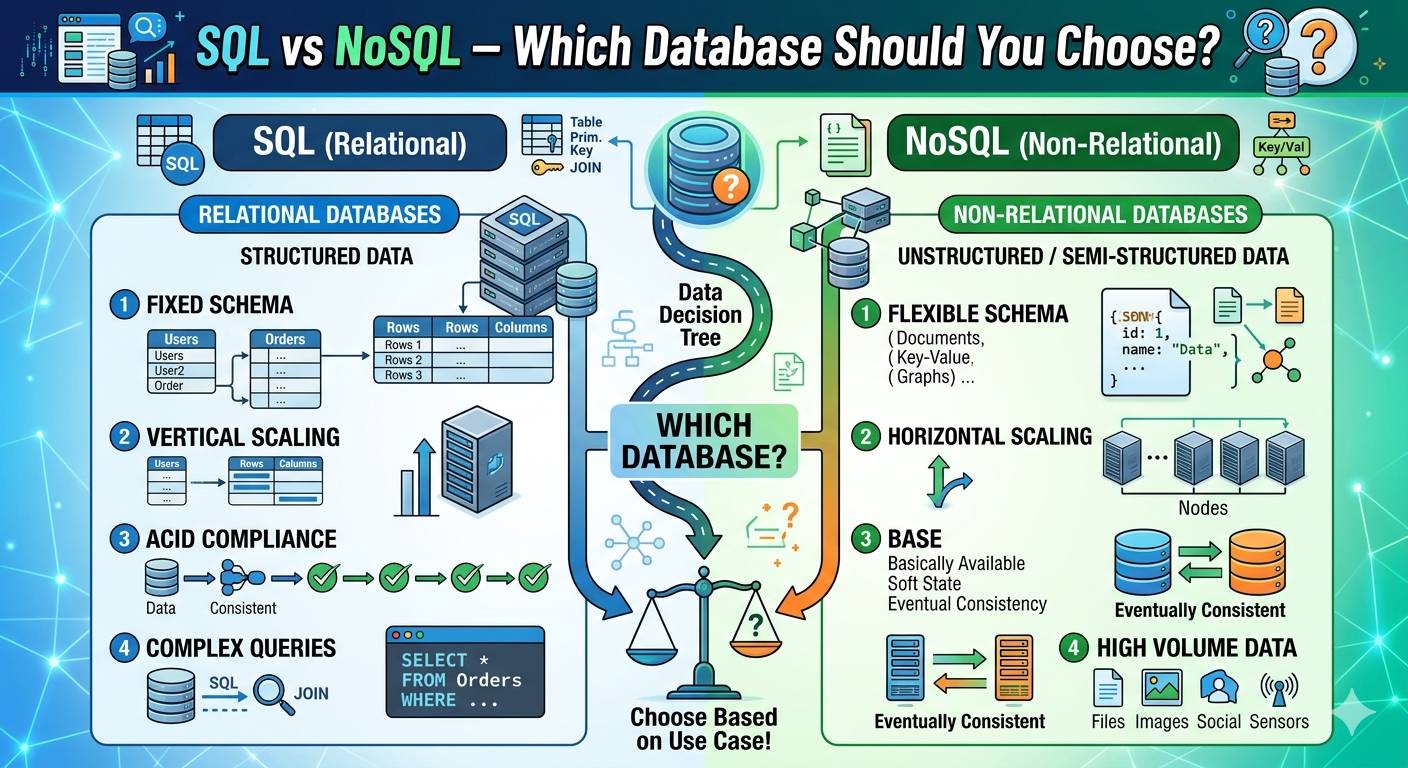
Choosing the right database is one of the most important decisions in modern application development. Two of the most commonly used database types are SQL (Structured Query Language) and NoSQL (Not Only SQL) databases.
Both are powerful, but they perform different purposes based on your project's requirements, data structure, and scalability demands. Understanding the difference between SQL and NoSQL may help developers, startups, and enterprises build applications that are efficient, scalable, and high performing.
What Is SQL?
SQL databases are relational databases that store data in structured tables with rows and columns. They use a predefined schema, which means that the data structure must be defined before storing it. Additionally, they support ACID properties (Atomicity, Consistency, Isolation, Durability), which ensure high reliability and data integrity.
Key Features of SQL
Table-based structure (rows & columns)
Fixed schema (strict structure)
Uses SQL language for querying and data manipulation
Supports complex queries and joins, and aggregations
ACID compliance (high data consistency)
Strong consistency and referential integrity
Popular SQL Databases
MySQL
PostgreSQL
Microsoft SQL Server
Oracle Database
What Is NoSQL?
NoSQL databases are non-relational databases that efficiently manage large volumes of structured, semi-structured, and unstructured data. They provide flexible schemas and are designed for scalability and high performance, It allows developers to store data formats like documents, key-value pairs, graphs, and wide columns.
Unlike SQL databases, NoSQL databases use a dynamic schema, meaning the structure can change easily without affecting existing data. This makes them ideal for modern applications with rapidly changing data.
Key Features of NoSQL
Flexible or schema-less structure
Supports multiple data models (JSON, key-value, graph)
Horizontally scalable (handles big data easily)
Faster development for dynamic applications
Designed for distributed systems
Popular NoSQL Databases
MongoDB
Cassandra
Redis
Firebase
CouchDB
When to Use SQL
SQL is the best choice when your application requires:
Strong data consistency and accuracy
Complex queries and relationships (joins)
Structured and stable data
Transaction-based systems
For example, a banking system manages transactions, customer accounts, and financial records using SQL databases. SQL ensures consistent and accurate data management.
When to Use NoSQL
NoSQL is ideal when your application needs:
High scalability and performance
Flexible or changing data structure
Large volumes of data (Big Data)
Real-time processing
For example, a social media app, such as Instagram or Facebook, employs NoSQL to manage millions of users, posts, likes, and comments in real time. The flexible structure allows rapid changes and scaling.
SQL vs NoSQL Comparison Table
Features | SQL | NoSQL |
|---|---|---|
Database Type | Relational | Non-relational |
Schema | Fixed and predefined | Flexible or schema-less |
Data Format | Tables | Documents, key-value, graph, wide-column |
Scalability | Vertical scaling | Horizontal scaling |
Transactions | Strong ACID support | Varies by database |
Query Language | SQL | Database-specific APIs or query languages |
Best For | Structured data and transactions | Big data and rapidly changing data |
Development Speed | Slower when schema changes | Faster for evolving requirements |
Advantages of Using SQL Databases
SQL databases have many benefits, including excellent data consistency and integrity. They are particularly well-suited to complex relationships and joins, making them a mature technology with extensive tooling. Furthermore, they provide robust transactional support, which is critical for data reliability. SQL databases are widely used in enterprise systems and play an important role in many applications.
Banking and financial systems, ERP and CRM applications, inventory management, and accounting software are some of the most common use cases, showing flexibility and importance in structured data management.
Advantages of Using NoSQL Databases
Advantages of NoSQL databases include their high scalability and distributed nature, allowing them to efficiently handle large volumes of data. They provide adaptable data models that respond to changing requirements, allowing for rapid development cycles. This adaptability is especially useful for real-time applications that require fast data processing.
Common uses for NoSQL databases include social media platforms, chat apps, Internet of Things (IoT) systems, content management systems, analytics, and big data solutions. Their capacity to handle these various applications emphasizes their importance in modern data management strategies.
Hybrid Approach: Using SQL and NoSQL Together
Many modern apps utilize a hybrid approach, leveraging the strengths of both SQL and NoSQL databases. SQL databases specialize in managing structured data such as orders, payments, and financial records, making them ideal for transactional processes and maintaining data integrity. NoSQL databases, on the other hand, specialize at managing unstructured data and can store product catalogs, user activity, and session data. This combination is especially common in industries like e-commerce, Software as a Service (SaaS), and business applications, where different data types and scalability are critical to performance and user experience. Organizations can adapt their data management methods to fulfill a variety of objectives while also increasing operational efficiency by merging both database types.
Both SQL and NoSQL databases are essential technologies in modern software development, but they are designed for different scenarios. SQL databases are best for applications that require structured data, strong consistency, and reliable transactions, while NoSQL databases specialize in environments that demand flexibility, rapid development, and large-scale horizontal scalability. Many modern applications adopt a hybrid approach to leverage the advantages of both.
Choosing the right decision (SQL and NoSQL database) is determined by your project's requirements, data model, growth expectations, and performance objectives. In many circumstances, combining SQL and NoSQL provides the perfect balance of consistency, flexibility, and scalability. Understanding the strengths of each strategy allows developers to create powerful, future-ready applications.
Frequently Asked Questions
Althaf Mohamed
Technical Author
Software Engineer and technical author specializing in web architectures, databases, and secure distributed systems.
Trending Now
Recent Posts

Beginner's Guide to Software Development: Everything You Need to Know in 2026
May 30, 2026
TypeScript vs JavaScript - Key Differences
May 04, 2026
API Status Codes & Meanings
May 04, 2026
What is an Application Programming Interface (API)
May 04, 2026
Network Security Basics – Threats & Protection Methods
May 04, 2026