What is Database Design?
 Althaf Mohamed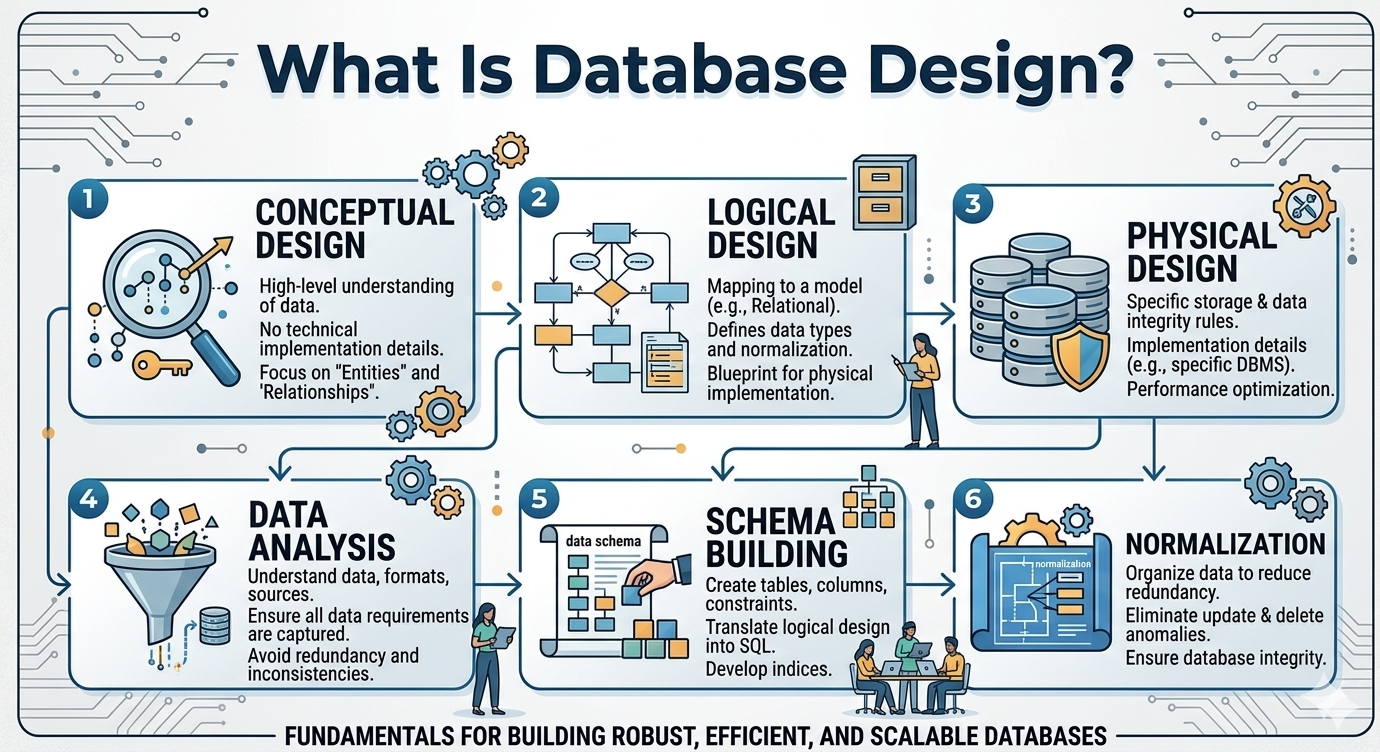
Database design is a fundamental part of building reliable software applications. Whether you are developing a web application, mobile app, or enterprise system, the way your data is structured can significantly impact performance, scalability, and data integrity.
A well-designed database ensures that information is organized efficiently, reduces redundancy, and allows applications to retrieve and update data quickly. Poor database design, on the other hand, can lead to slow queries, inconsistent data, and difficulty maintaining the system.
In this article, we will explore what database design is, why it is important, the key principles behind it, and the best practices developers should follow.
What is Database Design?
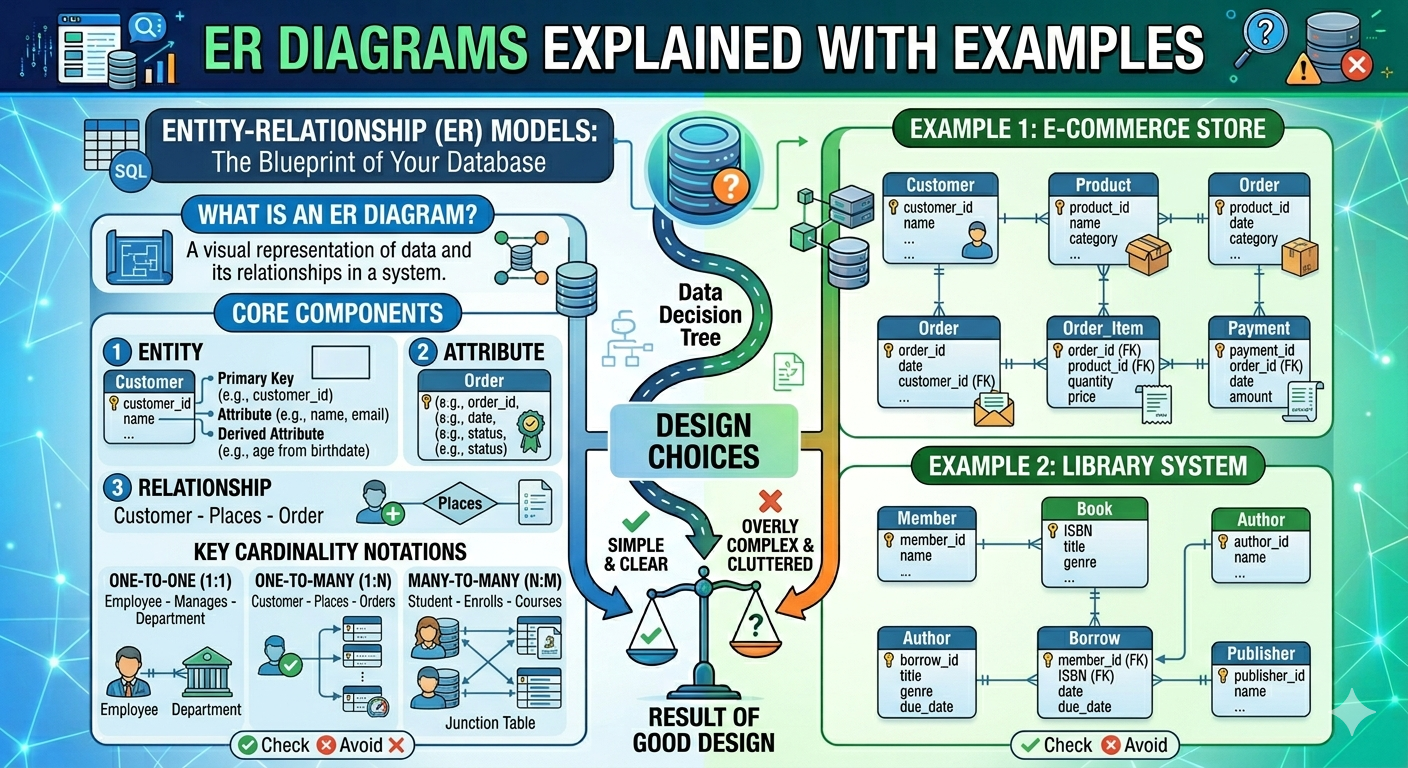
Database design is the process of organizing data into tables, relationships, and constraints in a way that ensures efficient storage, easy retrieval, and data accuracy.
It involves defining how data will be stored, how different pieces of data relate to each other, and how users and applications will interact with the database.
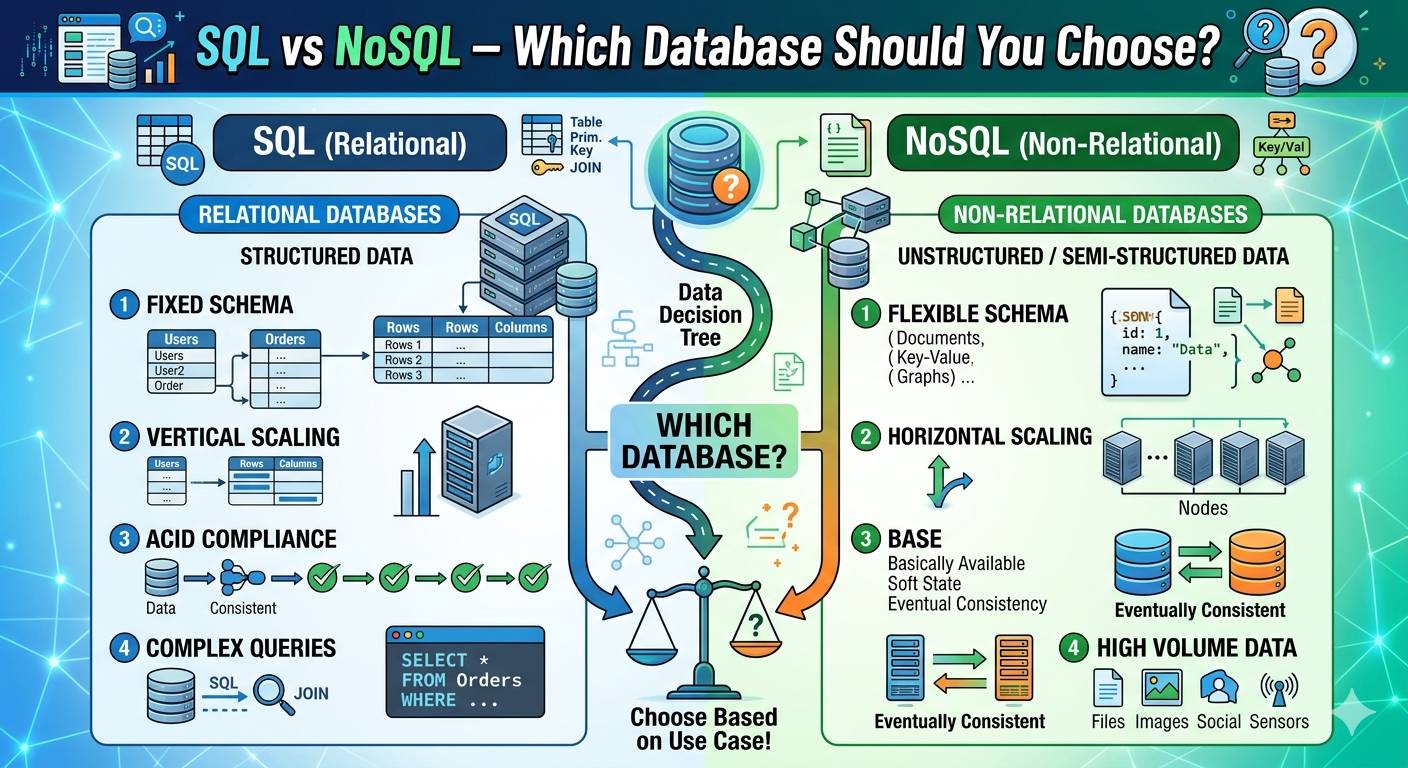
Commonly using database management systems are:
Microsoft SQL Server
MySQL
PostgreSQL
MongoDB
Oracle Database
A good database design helps developers manage large amounts of data while maintaining performance and consistency and scalability.
Why Is Database Design Important?
Proper database design plays a crucial role in the success of any application.
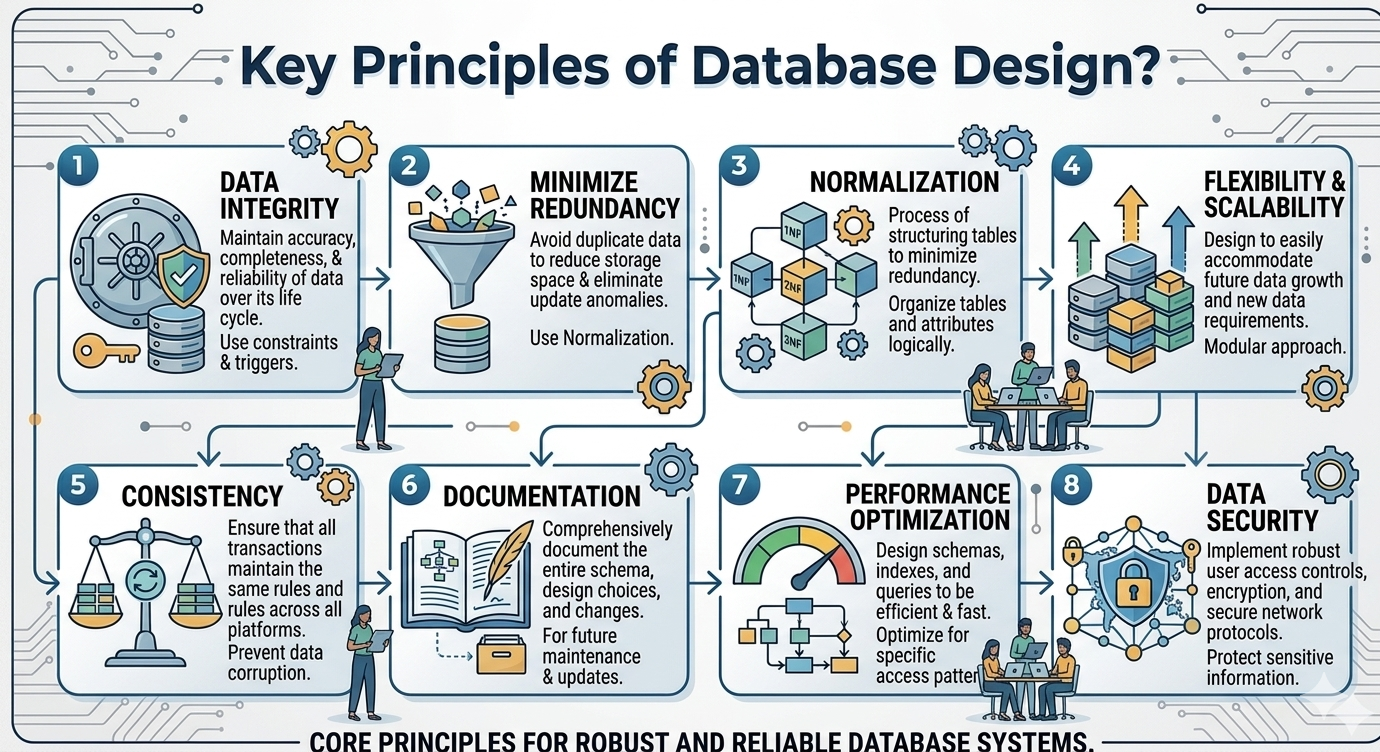
Improves Data Organization – Database design ensures that data is logically structured, making it easier to understand and manage.
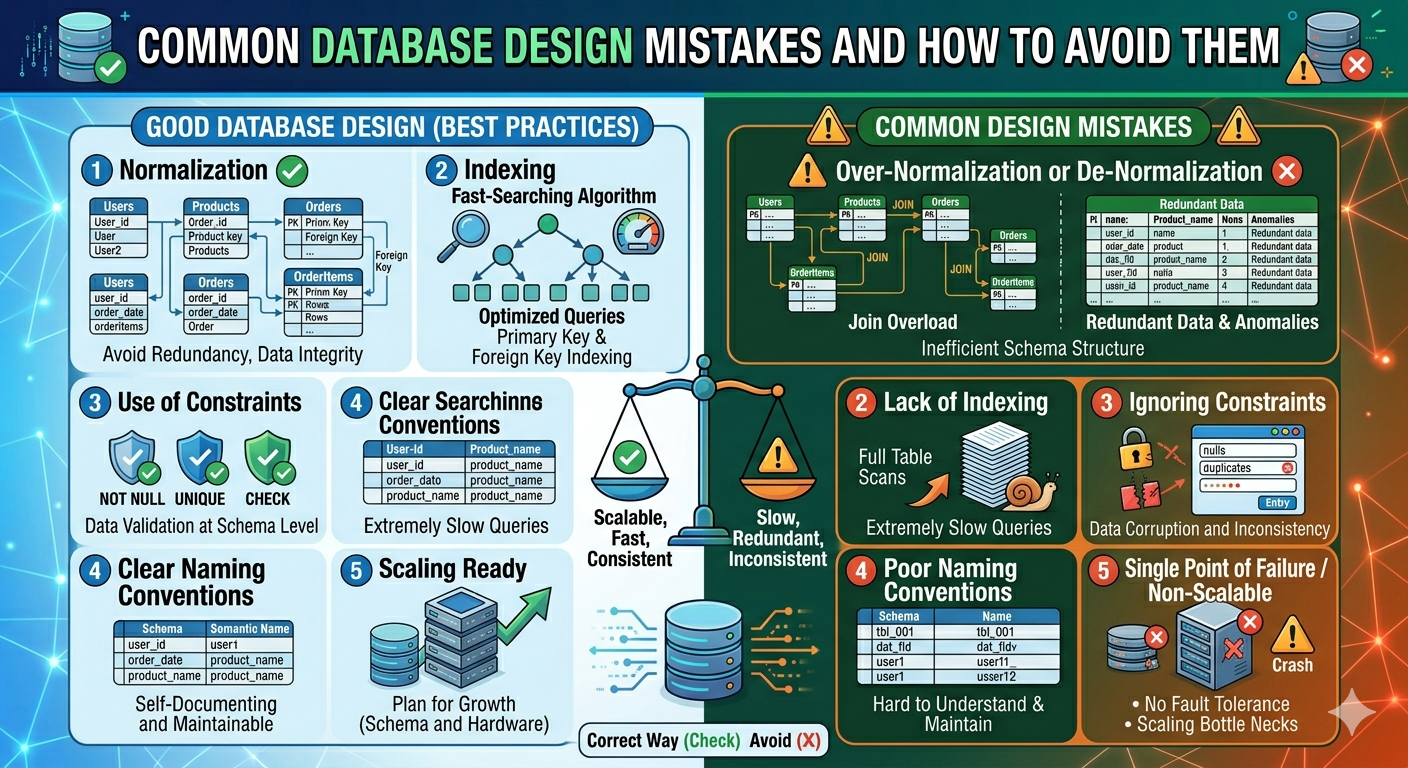
Reduces Data Redundancy – By structuring data correctly, duplication of information is minimized, which saves storage space and prevents inconsistencies.
Enhances Data Integrity – A well-designed database uses constraints and relationships to maintain accurate and reliable data.
Improves Application Performance – Efficient database structures help applications retrieve and update data faster.
Supports Scalability – Good design allows the database to grow as the application expands.
Key Components of Database Design
Entities - Entities represent real-world objects or concepts, such as Customers, Products, Orders, or Employees.
Attributes - Attributes describe the properties of an entity. For example, a Customer entity may include Name, Email, and Phone Number.
Primary Keys - A primary key uniquely identifies each record in a table.
Foreign Keys - Foreign keys establish relationships between tables.
Relationships - Relationships define how entities are connected:
One-to-One
One-to-Many
Many-to-Many
Constraints - Constraints enforce rules such as uniqueness, required fields, and valid data ranges.
Database Normalization
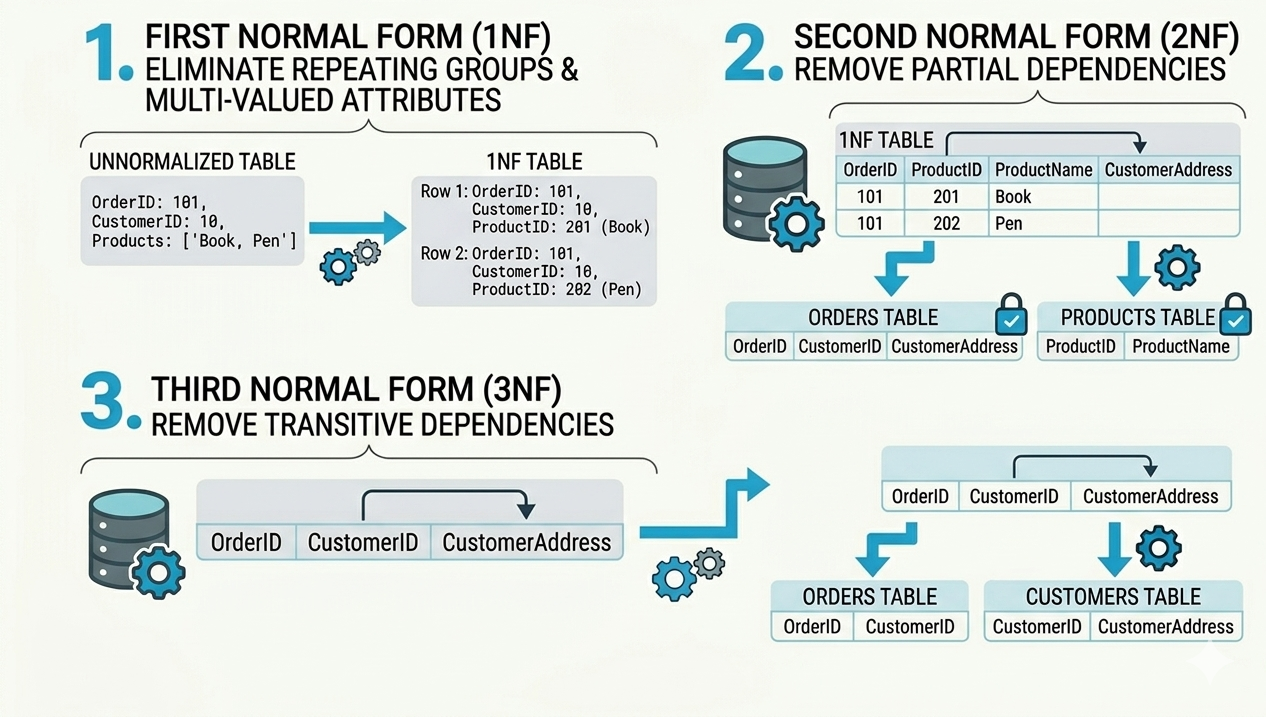
Database Normalization is a critical process in database design that involves dividing large tables into smaller, more manageable tables. This procedure creates relationships between these smaller tables, usually utilizing main and foreign keys. The primary objectives of Database Normalization are to reduce duplicate or redundant data, simplify maintenance, and maintain data accuracy and consistency throughout its lifecycle. Normalization improves the integrity and performance of a database by effectively structuring its contents.
First Normal Form (1NF)
First Normal Form (1NF) requires a table to have each column contain only atomic values and to avoid repeating groups or arrays. For example, instead of storing multiple phone numbers in a single field (like +1175XXXXXXX, +1145XXXXXXX), each phone number should be stored in a separate row or table.
Second Normal Form (2NF)
Second Normal Form (2NF) requires that a table is in First Normal Form (1NF) and that all non-key columns depend on the entire primary key. For example, in a table with a combined key of (OrderID + ProductID), attributes like CustomerName should depend on both keys, not just OrderID or ProductID individually. To achieve 2NF, data should be split into separate tables, such as Orders, Products, and OrderDetails.
Third Normal Form (3NF)
Third Normal Form (3NF) requires that a table is in Second Normal Form (2NF) and that no column depends on another non-key column. For example, in a table with CustomerID, City, and PostalCode, if PostalCode determines City, it leads to redundancy. To resolve this, City should be moved to a separate structure or the dependency should be eliminated.
Database Design Process
The database design process is a structured approach to create an efficient, scalable, and reliable database system. It ensures that data is stored in a way that improves application performance, protects data integrity, and meets business requirements. Each phase contributes significantly to the development of a solid database foundation.
Gather Business Requirements
Understand the system's requirements and the data that must be kept. This includes talking with stakeholders and determining essential company goals and rules.
Identify Entities and Attributes
Find the system's primary objects (entities), such as users, products, and orders. Then specify their properties (attributes), such as name, price, or email.
Define Relationships
Determine how entities are related. For example, a consumer may place multiple orders, indicating a one-to-many relationship.
Create an Entity-Relationship Diagram (ERD)
Create a visual diagram of entities, attributes, and relationships. This allows developers to properly comprehend the database structure prior to implementation.
Normalize the Database
Organize data to reduce duplication and improve consistency. This ensures data is stored efficiently and avoids redundancy issues.
Define Keys and Constraints
Set primary keys to uniquely identify records, and foreign keys to link tables. Constraints keep data accurate and enforce rules.
Create Indexes for Performance
Create indexes for commonly searched columns to speed up data retrieval. This improves query performance on large databases.
Test and Refine the Design
Check the database with real or sample data to find issues. Improve and optimize the structure based on performance and usability needs.
Database design is the core of all reliable software applications. It determines how data is stored, related, and maintained throughout the system's lifetime. A well-designed database boosts performance, reduces redundancy, assures data integrity, and allows for future growth.
Frequently Asked Questions
Althaf Mohamed
Technical Author
Software Engineer and technical author specializing in web architectures, databases, and secure distributed systems.
Trending Now

Recent Posts

Beginner's Guide to Software Development: Everything You Need to Know in 2026
May 30, 2026
TypeScript vs JavaScript - Key Differences
May 04, 2026
API Status Codes & Meanings
May 04, 2026
What is an Application Programming Interface (API)
May 04, 2026
Network Security Basics – Threats & Protection Methods
May 04, 2026